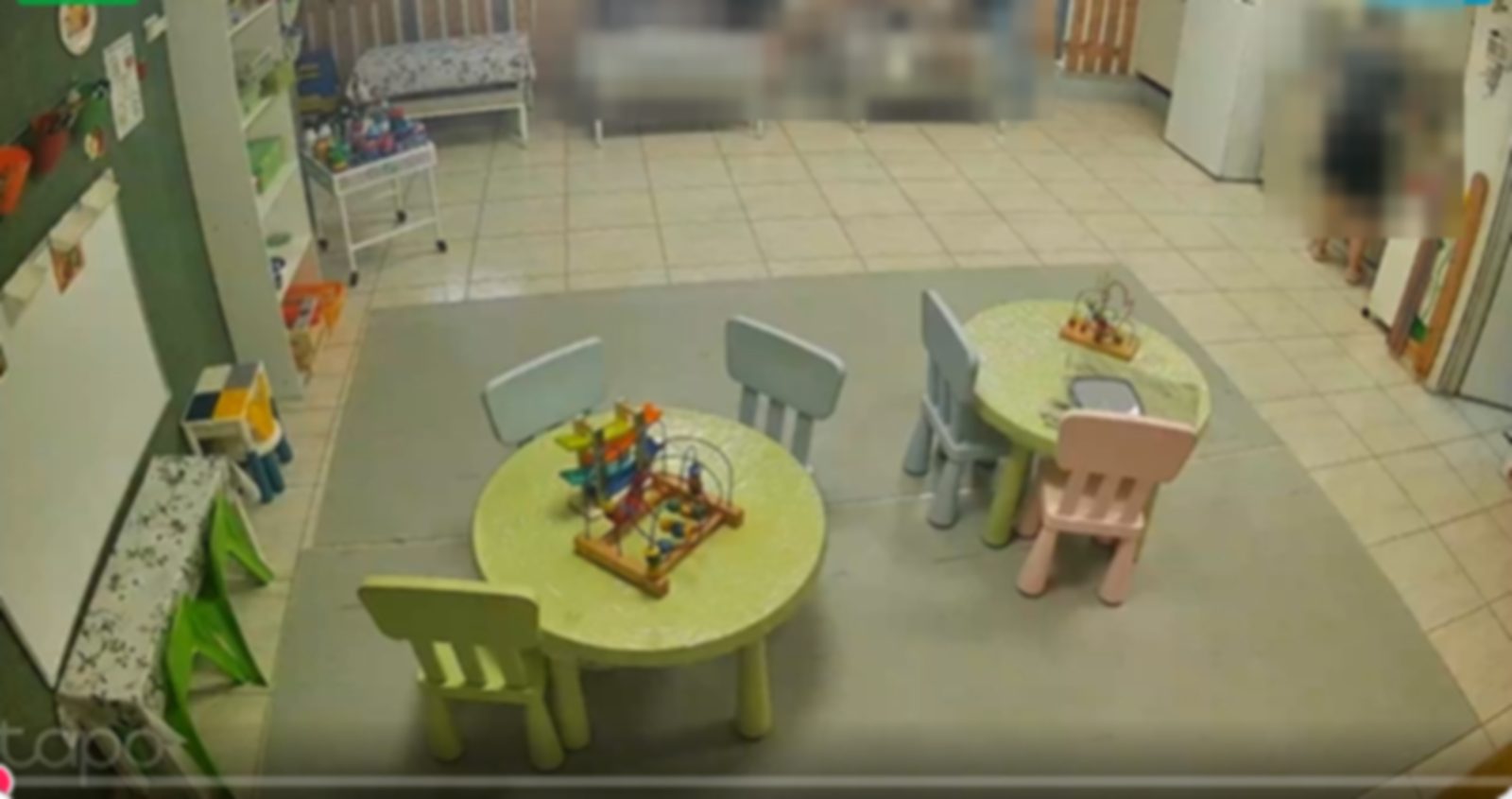
A frame from a daycare camera, faces blurred
A call to parents

We must stop this.
And it is in our hands.

Children are being harmed in daycare, and it is discovered by chance. The problem is clear, and the solution already exists.

We call on parents to uniteand demand an update to the Cameras Law: the cameras already in daycare should alert to danger in real time, to protect children while safeguarding privacy.

The solutionThe cameras already in daycare can alert in real time. The law does not allow it.
The demandAmend the Cameras Law
Sign the parents' declaration

Until now, parents led every change to the law.This time we lead together: daycare manager or staff member? Join us

A real frame from a daycare camera, from the Ein Tzofia system. Faces have been blurred to protect privacy.
2,473police cases for offenses against toddlers in care settings, 2017–2024
278cases in the first half of 2025. More than one and a half cases a day
400+acts of abuse in the Ariel indictment
27%of daycare centers inspected: cameras were not recording properly

In early November 2026, an indictment was filed against the director of a private daycare center in Ariel and two caregivers. According to the indictment, over a long period they committed more than 400 acts of abuse and assault against 17 babies and toddlers, some only six months old: blocking their airways, shaking, force-feeding, and locking them in a dark room.

No system raised an alert in real time. One of the mothers said she had noticed repeated bruises on her son, and that the police arrived before she could act. A week earlier, in Ra'anana, three caregivers were arrested after a toddler was taken to the hospital with an injury. In Lod, in 2025, parents no longer waited: they planted a recording device in the daycare themselves.

A parent. A doctor. Luck. That is how abuse is detected today, and every day that passes before it is discovered is another day of harm.

The solution already exists. So why are we all still waiting for the next disaster?!

When everything happens after the fact, it is already too late

Even when abuse is discovered, it is discovered too late. By the time a parent notices a bruise or a child ends up in the hospital, weeks of harm have already gone by. A year-and-a-half-old toddler cannot tell anyone, and the emotional damage stays with the child and the family long after the story leaves the headlines.

What parents do todayA recording device in the backpack: an act of desperation, not a solution

Parents should not have to become investigators. They need a system that protects all children, in real time and by law.

07:30 Recording starts10:42 The moment that matters16:00 Eight and a half hours of audio
Why isn't this a solution? Six reasons
  • Comes after suspicionBy then the child has already been harmed.
  • Hours of listeningEight hours of audio, every day.
  • Hears, doesn't seeCrying sounds the same when a child falls and when a child is hurt.
  • Breaks trustStaff feel attacked, even when they did nothing wrong.
  • Exposes other childrenRecords the whole daycare, without consent.
  • May be a crimeAccording to lawyers, it may be considered illegal wiretapping.

TrustOne case casts a shadow over the whole country

After every case, thousands of dedicated kindergarten teachers and caregivers are met with suspicion. Parents are afraid, and good staff leave.

Instead of suspicion, a tool that shows every day that the children are in good hands.

The law todayEverything is recorded.
Nobody watches!

Since 2018, daycare centers for toddlers have been required to record. But the footage is locked, and opened only after there is already suspicion.

Day 1: Everything is recordedNo one watched, except for a few minutes on one dayDay 30 to 90: Deleted
Recorded dayA few minutes of viewingMalfunction: no footageDeleted

And in many daycare centers, the cameras don't record at all

Even operators are not allowed to watch, so a malfunction is discovered only when the footage is requested. And then it turns out there is no footage.

27%of daycare centers inspected: cameras were not recording properly
54%of daycare centers inspected: a malfunction lasting 3 months or more
89%of private daycare centers: no monitoring of camera function
Example and sources

In Jerusalem, parents who planted a recording device discovered that the cameras had not been working for a year and a half.

Sources: State Comptroller, “Aspects of Supervising and Safeguarding the Well-being of Toddlers in Daycare Centers” (2026) · Kan News

The 2024 amendment to the law doesn't help

In 2018, after a baby died at a daycare and parents protested nationwide, the Cameras Law was passed. In 2024, after Rosh HaAyin, Ramla and Eilat, parents took to the streets again, and the law was amended (upheld by the High Court in 2025): a closed list of viewing options for parents. None of them is mandatory: the operator picks one, or stays exactly as before the amendment.

The three viewing options, and why none of them protects
  • Viewing at the daycare, up to once a weekParent representatives watch selected clips. A few minutes out of a whole week.
  • Remote viewing, 48 hours a monthIn practice parents watch a few minutes, without knowing what to look for.
  • Live stream to a phone, only if all parents agreeSomeone still has to watch all the time. And staff who are watched every moment work under pressure, and in the end it is the children who are hurt.

OversightThe daycare oversight budget: a 75% cut

The chart and the data

Daycare center oversight budget

In millions of NIS
2023 2023: NIS 190.5 million 190.5 2026 2026 (proposed budget): NIS 46.2 million 46.2 −75%
2026: proposed budget. Source: Berl Katznelson Foundation analysis (ynet, January 2026); master's thesis “The Fourth Track” (Oranim, 2026).

And on the ground: supervisors can't get to every daycare center

83daycare centers, on average, under the responsibility of one supervisor
14%of daycare centers inspected did not receive even one inspection visit a year

Source: State Comptroller, 2026

Under today's Cameras Law, I am required to record my staff, and I am forbidden from using the footage to help them.Aharon Nais, director of a kindergarten network
The solution: The Fourth Track

An example of technology that already exists

The camera that understands.

No extra camera and no extra screen: the existing cameras understand in real time and alert whoever can act.

This is not a simulation. It is a real report from an active pilot in a kindergarten, in partnership with Oranim College.
What you see in the videoThe system identifies who is in the room and each person's role, understands the situation, points out strengths and what needs attention, and suggests an alternative approach the staff can try tomorrow. The children and staff have been blurred, and staff names removed.
Ein Tzofia

Today vs. The Fourth Track

Today
The Fourth Track
Camera health
No monitoring. Malfunctions last for months
Continuous monitoring and immediate malfunction alerts

Today: No monitoring. Malfunctions last for monthsA camera that is off, blocked or faulty is detected within minutes, and an alert is sent to the operator and the supervisor. Today, such a malfunction is discovered only when the footage is already needed.

Prevention
None
Predicting risk before harm happens

Today: NoneDetects situations that precede harm: shouting, prolonged crying with no response, unusual physical contact, a staff member alone with too many children. It flags situations, not people.

When it is discovered
After a child is harmed
In real time, while it can still be stopped

Today: After a child is harmedA child crying alone, an unusual incident, an adult losing control: the alert arrives while it is happening. Not months later, if ever.

Who finds out
Police and supervisors, only after suspicion
Staff and management immediately, and in a serious incident an external oversight body as well

Today: Police and supervisors, only after suspicionIn a serious incident, the alert also goes to an external oversight body, and it cannot be deleted or hidden. That way, protection does not depend only on whoever runs the daycare center.

Who watches
An investigator after suspicion, or a parent watching for hours
No one. The system understands

Today: An investigator after suspicion, or a parent watching for hoursThe system processes what happens in the daycare and produces text: what happened, when and where. No one sits watching video, and no parent sees children who are not their own.

What is kept
Video of the entire day
Written insights, and selected clips for training

Today: Video of the entire dayEven a written insight about a child is sensitive information. Therefore: minimal data, children's and staff names encrypted, role-based permissions, a log of every access, deletion after a set period, and external oversight.

Professional support
One supervisor for about 83 daycare centers
Daily feedback for staff, with clear metrics

Today: One supervisor for about 83 daycare centersPeople say: we need good educators, not cameras. True, and good educators need support. Research shows that personal coaching and regular feedback are among the strongest ways to improve teaching quality (Kraft, Blazar & Hogan, 2018). Here the staff receive feedback and pedagogical support every day, like a mentor at their side: what worked, where the pressure points were, what to improve tomorrow. In the pilot study with Oranim College, staff quality-of-care measures improved by 48%. The insights are not used to rank employees or to make decisions against an employee.

What the parent knows
Whatever there was time to tell at pickup
Updates on their own child, continued at home

Today: whatever there was time to tell at pickupA child who struggled to separate in the morning: the parent gets a message that he calmed down after three minutes, and how the staff helped him. In the evening comes an insight about his development and an idea for a game at home, based on what happened that day. Staff don't always have time to guide every parent; here the process continues at home. The parent doesn't have to police the cameras, and receives information only about their own child.

Development
Depends on staff time and attention
Signs worth checking are spotted early

Today: depends on staff time and attentionWhen signs worth checking appear, for example a child who barely uses words, the system suggests referral to a professional and guides staff and parents on how to work with the child. It does not diagnose. People make the decisions.

Tap a row for an explanation

Ein TzofiaToddler group · Today
Needs attention · 10:42A toddler has been crying alone, apart from the group, for 12 minutes in the play area, with no adult nearby.
Strength · 09:15During morning circle, the teacher reflected the feelings of three children who were struggling, and the group calmed down.
Suggestion for tomorrowThe transition to lunch got crowded. Consider splitting into two groups.
This is what alerts and insights look like in the system. Examples are for illustration only.
See the system’s working interface from the pilot
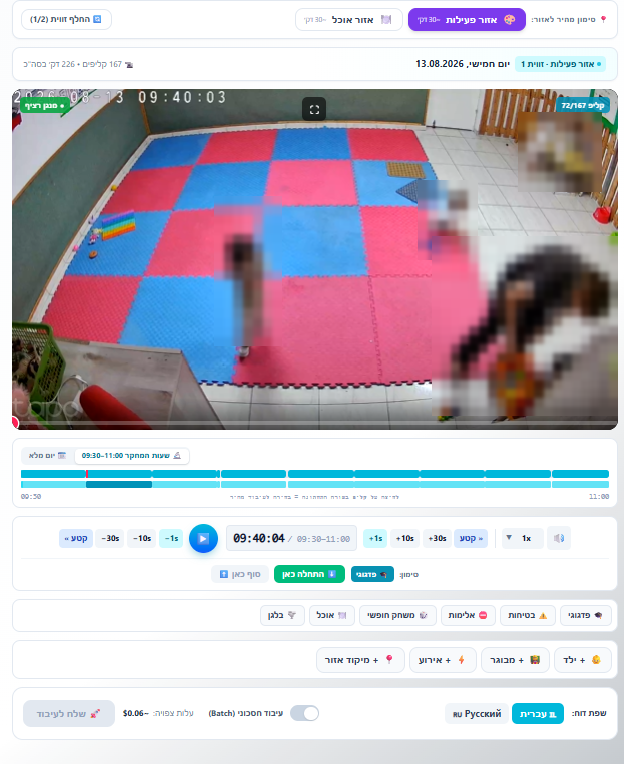
Ein Tzofia system screen in a kindergarten: video with blurred faces, a timeline and event markers
This is not a simulation. It is the system’s working interface in the pilot, used to check the quality of the analysis against the footage. A timeline of the day, analysis of segments, and events marked by type: pedagogical, safety, violence, free play, food. Under the track we are demanding, the responsible people in the setting receive alerts and written insights, and viewing a specific clip is allowed only for a focused, authorized and logged review. Faces have been blurred.Screenshot: Ein Tzofia

From the day the law allows it:

Tomorrow morningConnect to the existing camerasThe understanding layer runs on top of the infrastructure already installed in the daycare.
The first weekReal-time alerts and a daily reportAn alert to staff and management the moment something happens, and, in a serious incident, to an external oversight body as well. A daily report for the staff.
The first monthFully operational in the fieldThe whole daycare is covered. The director receives actionable insights for improving the daycare.
Three monthsA national standardThe Fourth Track becomes the standard in every setting. And parents receive developmental insights and updates on safety events involving their children.
The technology already exists. The only barrier is the law.Read more

Technology like this already works and is proven. For example, Ein Tzofia: operating in the field for about a year, across all age groups, and in a research pilot in partnership with Oranim College. The system was developed with the support and funding of the Israel Innovation Authority. And the track we are demanding defines a technological principle and a standard, not a product: it is open to any system that meets a strict regulatory standard, not just this one. And a complete plan is ready: draft wording for the amendment, a strict privacy and security standard, protection for staff, and pedagogical support. It is ready to be submitted to the Knesset.

A declaration by parents and educators

Public declaration: Updating the Cameras Law

To the Minister of Education and the Knesset Education Committee. Four requests:

A fourth track in the law

The existing cameras alert in real time, without ongoing viewing. Open to any system that meets the standard.

A strict standard

Prior approval, external accuracy testing, and oversight by the Privacy Protection Authority.

Rollout alongside research

Deployment from the first phase, alongside an independent evaluation study.

A dedicated budget

In addition to existing oversight, not instead of it.

A principle, not a product. The declaration will be submitted once it reaches 10,000 signatures.

Read the full declaration and sign

Parents, it's time to unite.

Every amendment to the law so far happened because parents refused to stay silent.

This time we lead together. Daycare manager or staff member? Join us

Sign the parents' declaration for the Fourth TrackIt will be submitted to the Minister of Education and the Knesset Education Committee.Sign

Get your daycare’s parents on board

A ready-made message. Send it to your daycare's parents group. And talk to the daycare director: there is a section for directors, with answers to their concerns.

Questions and concerns

Short answers to questions parents and staff ask us. Each answer notes what the declaration asks the law to require.

Can the system make mistakes?

Yes. Any system can make mistakes, so we distinguish between two things. When an alert points to danger to a child, people respond immediately and protect the child, without waiting for any review. But a finding that someone caused harm, or any step against an employee, happens only after a proper human review. An insight is a signal to check, not a verdict, and the external research we are demanding will measure and publish the error rate.

What happens once an alert comes in?

The alert goes in real time to the person responsible in the setting, who steps in immediately, makes sure the child is safe and handles the situation. A serious alert is also sent, in parallel, to an external and independent body, such as an oversight authority or a dedicated call center, so that protection does not depend only on the people inside the setting. Alerts cannot be deleted or hidden, and the incident and how it was handled are logged. If there is a suspicion that a child was harmed, the duties that already exist in the law apply, including reporting to the competent authorities. Any determination about an employee's responsibility is made only after a proper inquiry, and not on the basis of the alert alone.

Does it replace oversight and staff?

No. It is a tool in the hands of staff and supervisors, not a replacement for them. Kindergarten teachers and caregivers are the ones who care for the children, and supervisors are the ones who support the settings. That is why the declaration demands a dedicated budget in addition to existing oversight resources, not instead of them.

Who receives the information, and who may access it?

Only those who need to act: the responsible person in the setting receives alerts, and serious alerts also go to an external and independent body; the staff receive feedback on their work and pedagogical support; and oversight bodies receive a daycare-level picture of the situation. Parents do not see information about other children. Every access is logged, the information is deleted after a set period, and the Privacy Protection Authority provides oversight.

Does the system flag employees as "dangerous"?

No. It detects situations that increase risk, such as shouting, prolonged crying with no response, a staff member alone with too many children, or overload, and alerts so that the pressure can be eased and help provided. It does not predict who will cause harm, and it does not rank people.

Will the information be used to rank employees or make decisions against them?

No, and this is one of the conditions in the declaration: a ban on ranking employees, and a ban on any decision against an employee based on an insight alone, without human review. The goal is to protect the children and strengthen the staff. When there is a suspicion that a child was harmed, the duties that exist in the law continue to apply, as they do today.

What does the support of the Israel Innovation Authority mean?

The Israel Innovation Authority supported and funded the development of Ein Tzofia's technology, as it does with Israeli technology companies. Such support is granted after a professional review of the project, so it indicates that the technology is serious and has been vetted. To be precise: the support was given for developing the technology, and it is not the Authority's endorsement of this initiative, the declaration, or the change to the law.

Does signing require using Ein Tzofia?

No. Signing is support for a policy change, not for a product. The Fourth Track defines a technological principle, not a product: it is open to any system that meets a strict regulatory standard, including prior approval by a competent government body, external accuracy testing before deployment and on an ongoing basis, information security and privacy requirements, and periodic independent audits. Signing does not commit you or your daycare to anything, and we will not use your details for marketing.

More initiatives for the children

This struggle is bigger than any one initiative. We support extending the camera law to all early-childhood settings from birth to age 6, including municipal kindergartens, as the parents' petition “Safety for Every Child” demands.

How we complement it: the Fourth Track does not replace parents' viewing, it adds to it: cameras that alert in real time, even in the moments when no one is watching.

About the initiative and its initiator

I have been running a kindergarten network for twenty years. I know the staff, the workload, the caregiver left alone with eight toddlers. Most of the women who work in daycares are more devoted to the children than words can describe. But these cases will not disappear on their own, and all the state has done so far is slap a band-aid on them.

Disclosure: this initiative is led by Aharon Nais, director of a kindergarten network and founder of Ein Tzofia, which develops technology of the kind shown here. We present it as an example showing that the solution already exists. The declaration itself demands a track open to any system that meets a strict regulatory standard, and signing it is not an endorsement of any particular product. For questions, media and legislators:
Phone050-878-7431
About the companyemma-il.netlify.appVisit
The technology behind the example

Made in Israel: technology that understands children

Ein Tzofia identifies people and roles, understands situations, alerts in real time and supports the staff. It generated the report shown in the video.

  • About a yearoperating in the field
  • All agesin daycare centers and kindergartens
  • Research pilotwith Oranim College
  • Israel Innovation Authoritysupported and funded
The same technology powers Emma, for parents

Ein Tzofia is shown here as a demonstration only: the track we are demanding is open to any system that meets a strict standard.

Sources

  1. Times of Israel: Indictment at an Ariel daycare center (November 2026)
  2. Maariv: A mother's testimony in the Ra'anana case (November 2026)
  3. Kikar HaShabbat: The father of a toddler in the Ra'anana case (November 2026)
  4. Walla: Indictment at a Lod daycare center (March 2025)
  5. Reshumot, Book of Laws: Installation of Cameras for the Protection of Toddlers in Daycare Centers Law, 5779-2018
  6. Ministry of Education: Mandatory camera installation in daycare centers
  7. HCJ 70206-12-24: Petition against the 2024 amendment dismissed (October 2025)
  8. Privacy Protection Authority: Guide to cameras in daycare centers
  9. ynet: Cameras Law amendment receives final approval (November 2024)
  10. Kipa: The three viewing tracks in the amendment to the law (2024)
  11. mako: Are parents allowed to record at daycare? (April 2022)
  12. ynetnews: Two babies died at an unlicensed daycare in Jerusalem (January 2026)
  13. Israel Hayom: Caregiver arrested at a Jerusalem daycare center (August 2025)
  14. Maariv: Caregivers arrested in Givat Olga, Haifa (January 2025)
  15. State Comptroller: Aspects of Supervising and Safeguarding the Well-being of Toddlers in Daycare Centers (June 2026)
  16. Kan News: Parents exposed abuse at a daycare, and the cameras weren't working
  17. State Comptroller: Report on daycare centers (2022)
  18. Srugim: The amendment to the law passed in the Knesset, November 12, 2024
  19. ynet: Berl Katznelson Foundation analysis, budget cut for implementing daycare oversight regulations (January 2026)
  20. Nais, A. (2026). “The Fourth Track.” Master's thesis (M.Ed) in Technological-Pedagogical Innovation and Entrepreneurship, Oranim College.